
Reviewed · WHALE WATCHING IN MOOREA
Swimming with Whales in Moorea (Half Day tour)
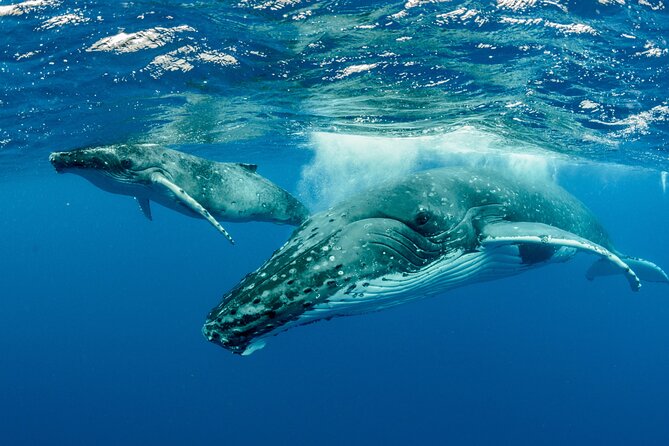
A mother humpback and calf gliding past you in open water is the sort of moment that can define a French Polynesia trip. This four-hour Moorea Expedition outing aims for that encounter from July through late November, while keeping the group to no more than six people per boat. I like the small scale and the careful approach to the whales. I also like that non-swimmers can remain aboard and still watch the action.
The main caution is simple: this is not a casual snorkel. You need to be comfortable in open water, able to use a mask and snorkel, and fit enough to swim when conditions are choppy. Whale sightings are never guaranteed, and rough seas can make even a successful outing tiring.
In This Review
- Key points to know before booking
- What the Moorea whale tour is really like
- The boat ride and first search
- Entering the water with humpback whales
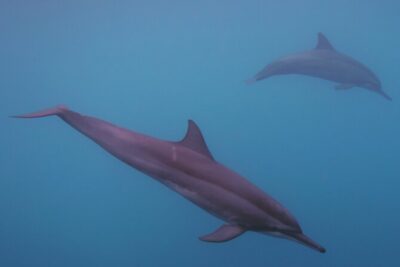
- Dolphins, rays, sharks, and turtles
- The guides and the safety approach
- Life jackets, wetsuits, and what to bring
- How much value do you get for $305.30?
- The best season and the role of weather
- Who should book this Moorea experience?
- Final call: is it worth booking?
- FAQ
- How long does the Moorea whale-swimming tour last?
- When can I swim with humpback whales?
- Are humpback whale sightings guaranteed?
- How many people can join the boat?
- Do I need strong swimming skills?
- Is snorkeling equipment provided?
- Do I have to wear a life jacket?
- What happens if weather cancels the tour?
Key points to know before booking
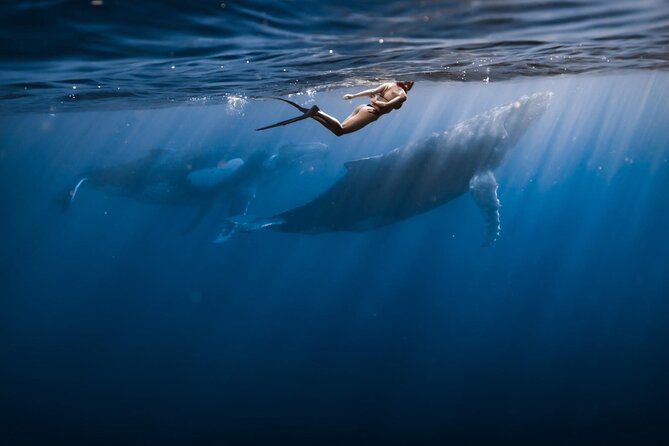
- Six people per boat: From 2025, government rules allow only six people per boat to swim with humpback whales.
- Whale season runs July to late November: The tour’s main goal is a whale encounter, but dolphins, stingrays, sharks, and turtles may also appear.
- Strong swimming skills are required: This is open-ocean swimming, not a gentle lagoon lesson.
- Wetsuits can replace the life jacket: French law requires a life jacket unless you wear a shorty or full neoprene wetsuit.
- The crew puts safety first: Guides such as Johnny, Joe, and Laura have been praised for clear instructions and respectful behavior around whales.
- Bring seasickness medicine and a camera: Choppy water is possible, and a GoPro can record whale song and close underwater views.
What the Moorea whale tour is really like
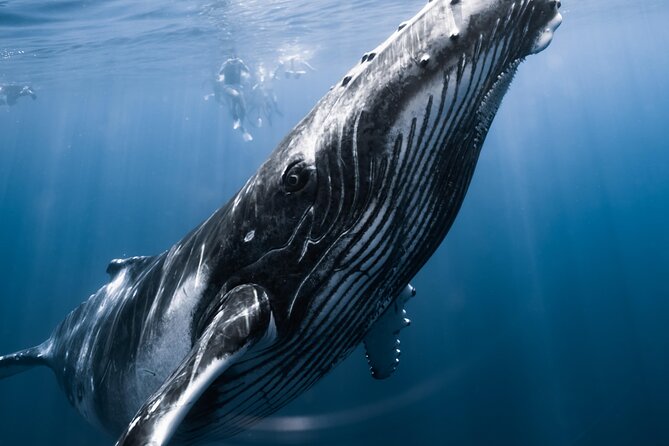
This is a wildlife expedition, not a timed parade of attractions. You meet at Moorea Expedition in French Polynesia, board a small boat, and spend the morning or afternoon searching the surrounding waters for humpback whales.
The listed duration is about four hours. That sounds generous, but the clock includes boat travel, searching, safety briefings, entries into the water, and the return ride. Some outings produce several water entries. Others may involve long stretches of watching and waiting.
That waiting is part of the deal. Whales move on their own schedule, and the crew cannot force an encounter. One outing produced dolphins but no whales, while another found a mother and calf within minutes. You should book this as a chance to observe wild animals, not as a guaranteed swim.
More Whale Watching in Moorea
- Whale Tour – Observe and swim with whales
★ 5.0 · 257 reviews - Swim with humpback whales
★ 5.0 · 224 reviews - Humpback whale watching and marine life in Moorea
★ 5.0 · 199 reviews
The boat ride and first search
The captain and guide begin by explaining how the activity works. Pay close attention here. The crew needs you to understand how to enter the water, how to stay with the group, and how to behave around whales.
The boat then heads out to look for signs of marine life. The captain may watch for whale activity at the surface, while the guide explains behavior and identifies other species. Reports from this operation describe sightings of dolphins, stingrays, blacktip sharks, turtles, and several humpback whales.
You may see whales from the boat before anyone enters the water. This is important because a boat sighting is not a consolation prize. It lets you watch the animals’ movement and gives the crew time to judge if an in-water encounter is suitable.
The boat itself is relatively small, which helps keep the group from feeling crowded. It also means the ride may feel more exposed than a large sightseeing vessel. If you are prone to seasickness, take appropriate medicine before departure. One particularly practical tip is to do this in advance, since choppy water can turn a beautiful morning into a miserable one.
Entering the water with humpback whales
If conditions and whale behavior allow, the crew directs you into the sea. You receive snorkeling equipment and flotation gear on board, and bottled water is included. You must be confident using a mask and snorkel before attempting the whale swim.
The effort is often easy to moderate, but it can become harder when the sea is rough or the whales move quickly. You may need to swim at a good pace and keep your bearings in open water. This is why the strong-swimmer requirement matters. It is not just a formality.
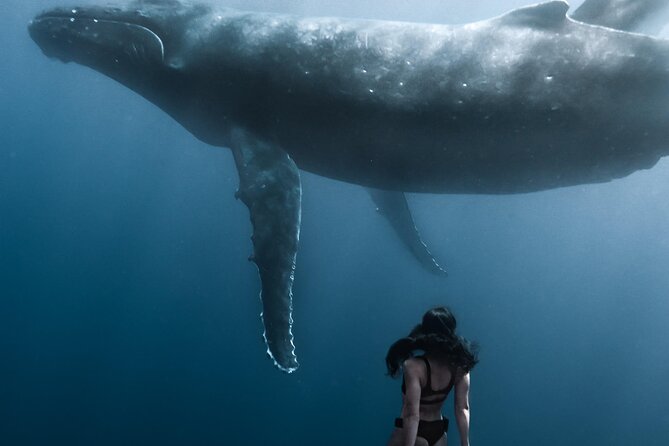
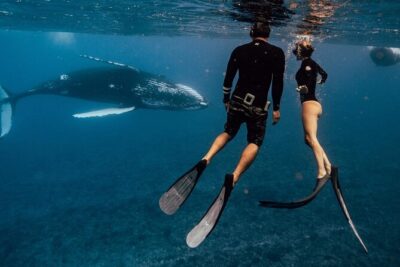
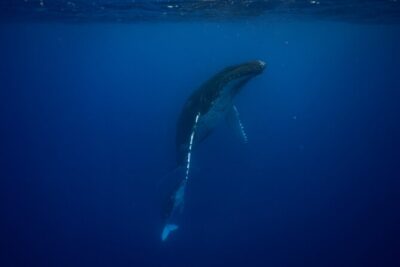
The guides work to place the group at a safe distance, then help you position yourself for a view. The experience may involve floating near whales as they rest below, watching them surface, or following their movement to another resting area. A mother and calf are common highlights in the most successful encounters, but the animals decide how close they come and how long they stay.
You should also expect strict limits around the animals. The crew’s job is not to chase a whale until everyone gets a perfect photograph. The best moments often happen when the group remains calm and gives the animals room to choose their path.
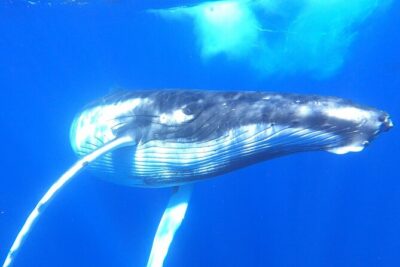
Several accounts describe whales passing directly beneath or in front of the swimmers. That can happen, but it is not something you can demand. The most useful attitude is patience. Bring a smile, as one guide advised, and accept that nature may provide a spectacular show from the boat rather than a close swim.
Dolphins, rays, sharks, and turtles
The whale search can produce a full morning even when humpbacks are scarce. Dolphins may appear during the boat ride or near a snorkeling stop. Stingrays and blacktip sharks have also been seen, along with turtles.
These encounters add real value to the tour because the trip is not reduced to one yes-or-no question about whales. Still, the animals are wild and sightings vary. You should not book expecting a fixed list of species.
A swim with rays or small sharks can also make a good final stop after the whale search. It gives you a different kind of marine-life encounter, usually with more predictable movement than a passing humpback. The tour description allows for these animals, but it does not promise a separate stop on every departure.
Same lagoon, a completely different day on the water:
- Moorea 6-Hour Snorkeling and Lunch Shared Tour
★ 5.0 · 1,758 reviews - Moorea 4WD Tour Inc. Belvedere, Pineapple Farm, Magic Mountain…
★ 5.0 · 967 reviews - Snorkeling excursion, discovery of the lagoon, small group.
★ 5.0 · 861 reviews - Franckyfranck Tours Moorea – Half day Tours
★ 5.0 · 817 reviews
The guides and the safety approach
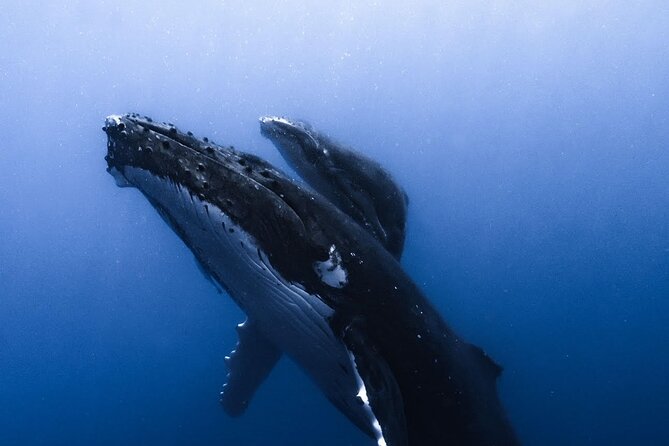
The human side of this experience matters. Several guides have been singled out for clear instructions, marine-life explanations, and calm handling of the group. Johnny is often noted for his friendly guidance, while Joe and Laura have been praised for helping people feel secure in the water. Captain Grace has also been associated with underwater photography on some outings.
The crew’s strongest quality is its attention to safety for both people and whales. Guides decide when it is appropriate to enter the water, how close to approach, and when to move on. That can feel conservative if you want unlimited time beside an animal, but it is the right trade for a responsible wildlife encounter.
Communication may not always feel equally smooth for everyone. The tour can operate in French and English, and at least one person described feeling left out during casual conversation when most of the group spoke French. Instructions were provided, but if you want frequent commentary in English, ask about language arrangements before booking.
The small group helps here. With a maximum of six people, the guide has a better chance of seeing who needs help and keeping the group together. It also gives the captain more room to work around the animals without managing a crowded boat.
Life jackets, wetsuits, and what to bring
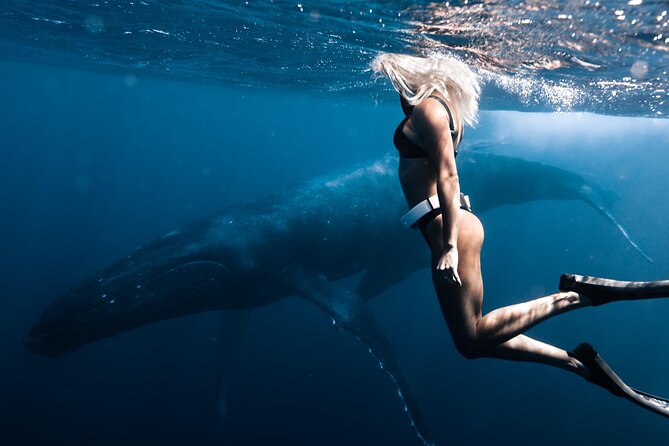
French law requires life jackets during whale swimming tours. The stated exception is for people wearing a neoprene wetsuit, either a shorty or a full suit.
The boat carries life jackets. Wetsuits may be rented from a third party, so contact the operator ahead of time if you want one. A wetsuit can provide warmth and buoyancy, and it lets you avoid the life-jacket requirement under the stated rule. Do not assume a rental is automatically waiting at the dock.
Bring your own sunblock and towel because neither is included. Bottled water and snorkeling equipment are supplied. If you have a GoPro or another waterproof camera, it can be worth bringing. One person reported capturing whale song with a GoPro, and several accounts describe memorable underwater views.
A camera should not become your main task. The best encounters can be brief, and fiddling with equipment may cause you to miss a whale moving beneath you. Use a secure strap and keep your attention on the guide and the animal.
How much value do you get for $305.30?
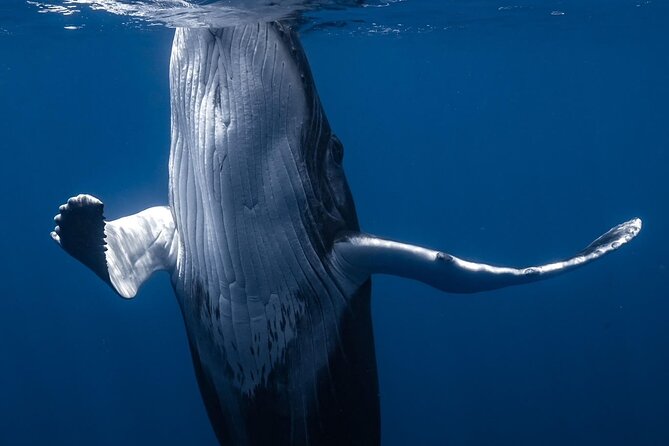
At $305.30 per person, this is an expensive half-day. The price is easier to justify if your priority is a small-group wildlife trip rather than a standard reef snorkel.
You are paying for a boat, a limited number of people, snorkeling equipment, flotation gear, bottled water, and a crew focused on finding and safely approaching large marine animals. The six-person limit matters. A cheaper trip with a much larger group may provide less room in the water and less direct attention from the guide.
The value depends heavily on your expectations. If you see humpbacks, dolphins, and other sea life, the cost can feel fair for a rare experience. If whales stay away, you may return disappointed, even if the crew works hard and the dolphin or reef encounters are good.
There is also an important comparison to make. This is designed for people who want to swim with whales. If you are not a strong swimmer, paying for the full experience may not be the best use of your money. The operator offers a non-swimming tour, and non-swimmers on this kind of outing can remain on the boat, but you should choose the option that matches your ability from the start.
The best season and the role of weather
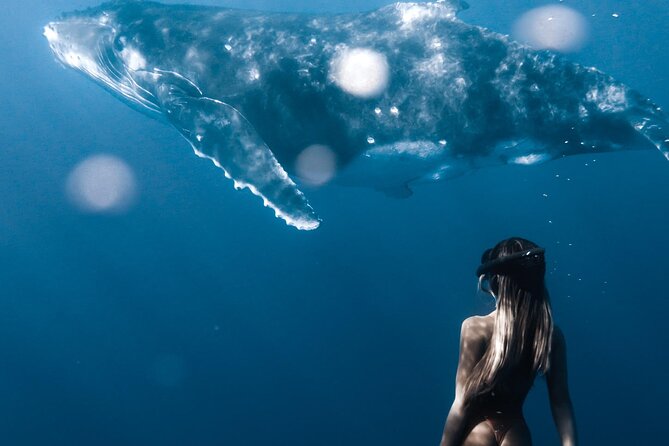
The main whale-swimming period runs from July through late November. The operator describes this as the season when humpback whales are present in Moorea waters.
Late-season trips can still work. One outing in mid-November, close to the last day of the season, produced a mother and calf. But the season does not remove the normal uncertainty of wildlife watching. Ocean conditions, whale behavior, and the animals’ location all affect the day.
Weather also matters. The tour requires good conditions and may be canceled if the sea or weather is unsuitable. In that case, you are offered another date or a full refund. If the minimum number of people is not met, the same choices apply.
For a flexible itinerary, this is a good reason to schedule the tour early in your Moorea stay. That leaves room to move it if weather causes a cancellation. The stated cancellation policy allows a full refund if you cancel at least 24 hours before the start time. Changes or cancellations within 24 hours are not accepted for a refund.
Who should book this Moorea experience?
I would choose this tour if you are comfortable snorkeling in open water and want a serious wildlife encounter. It suits confident swimmers, nature-focused people, photographers who can work quickly, and anyone willing to wait for animals rather than demand a fixed schedule.
It is also a strong choice for a small family group or a pair of friends who prefer personal attention. Six people per boat is a major advantage when guides need to explain behavior, manage water entries, and keep everyone in sight.
I would think twice if you rarely snorkel, dislike boat motion, or need a guaranteed activity at a precise time. Rough seas can make the swim difficult, and no crew can promise a whale sighting.
Non-swimmers are not completely left out, since they can watch from the boat. Still, if your main goal is to get into the water, choose this only when you can swim comfortably and keep up with the group.
Final call: is it worth booking?
Yes, if you understand the conditions. Swimming near a mother and calf, hearing whale song, or watching a humpback pass below you can be a once-in-a-lifetime event. The small boat, six-person limit, and careful approach make this more appealing than a crowded marine-life cruise.
Book it for the quality of the chance, not for a guarantee. Bring a towel, sunblock, a waterproof camera, and seasickness medicine if you need it. Wear or arrange a wetsuit if you want to avoid the life jacket, and be honest about your swimming ability.
If you want whales but not the physical challenge, choose the non-swimming option instead. If you are ready for open water, patience, and a little uncertainty, Moorea Expedition offers one of the island’s most memorable ways to meet its marine life.
FAQ
How long does the Moorea whale-swimming tour last?
The experience lasts approximately four hours and ends back at the Moorea Expedition meeting point.
When can I swim with humpback whales?
The main whale-swimming season runs from July through late November.
Are humpback whale sightings guaranteed?
No. The tour aims to find humpback whales, but sightings depend on conditions and whale behavior. Dolphins and other marine species may be encountered instead.
How many people can join the boat?
The activity has a maximum of six people. From 2025, government regulations allow only six people per boat to swim with humpback whales.
Do I need strong swimming skills?
Yes. You should have strong swimming ability, snorkeling experience, and a good level of physical fitness. Open-ocean conditions can make the activity harder.
Is snorkeling equipment provided?
Yes. Snorkeling equipment and flotation devices are available on board, and bottled water is included.
Do I have to wear a life jacket?
French law requires life jackets for whale-swimming tours unless you are wearing a neoprene wetsuit. A shorty or full wetsuit qualifies for the stated exemption. Life jackets are available on board, and wetsuits can be rented through a third party.
What happens if weather cancels the tour?
If poor weather causes a cancellation, you are offered a different date or a full refund. If the minimum number of people is not met, you are offered a different date or experience, or a full refund.
Just added around Moorea
- Yoga at sunrise at Sofitel Moorea, overlooking Tahiti★ 5.0 · 3 reviews
- moorea tubing★ 5.0 · 12 reviews
- Whale Watching Moorea (non-swimming)★ 4.0 · 12 reviews
- Snorkeling Tour in Moorea Aquatic Adventure Half Day★ 5.0 · 4 reviews
- Watch and Swim with Humpback Whales in Moorea★ 5.0 · 3 reviews
- Unique photo shoot in the heart DE Moorea: Beach & mountain combo★ 5.0 · 3 reviews
- Snorkeling Safari Moorea (Half Day Tour)★ 5.0 · 3 reviews
- Shared Transfer : Hotel to Moorea Airport (or) Pier★ 4.5 · 9 reviews
Whale Watching in Moorea, compared.
Humpback whale watching and marine life in Moorea
Read our review →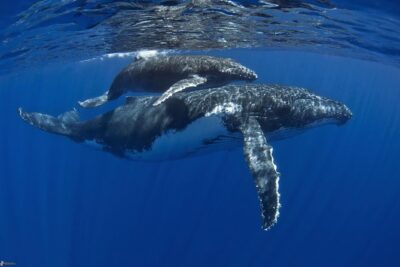
Private tour observing and swimming with humpback whales in Moorea
Read our review →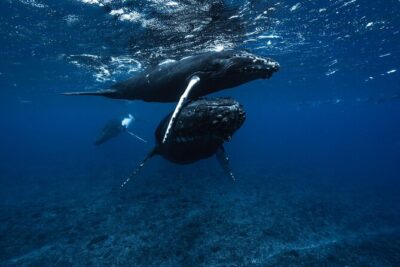
Browse the lists this tour appears in